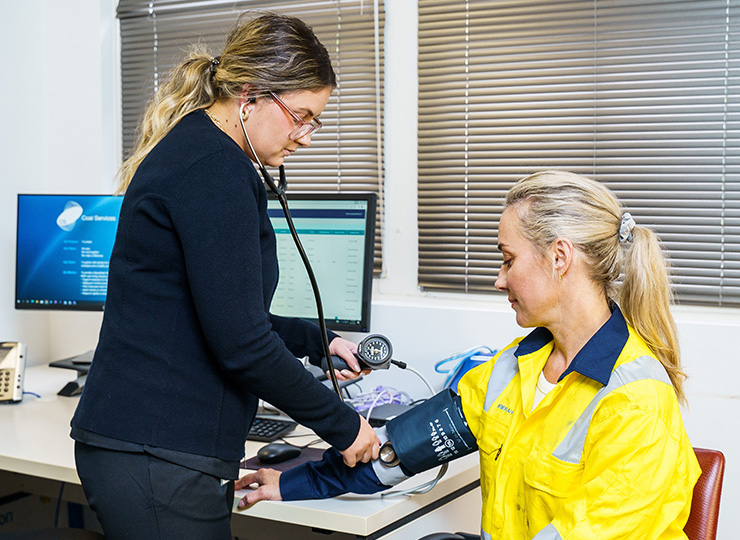


Health assessments
No. The Order 45 Health Assessment requirements are the same for all coal mine workers, regardless of risk category. The required information and health examinations in a health assessment are detailed in Schedule 1 of Order 45.
Risk categories have been introduced to assist approved medical practitioners in selecting the most appropriate medical investigations when assessing a coal mine worker’s fitness for work, particularly when a medical condition has been identified. This ensures fitness for work decisions are evidence-based and aligned with NSW Coal Industry Health Standards, while avoiding unnecessary follow-up appointments and testing.
To meet the requirements of Order 45, a chest X-ray must comply with the Clinical and Service Standard. This means the chest image must be reported to the ILO International Classification of Radiographs of Pneumoconioses and independently reviewed by a minimum of two medical practitioners who are:
- Registered with AHPRA as radiologists with unrestricted practice in Australia, and
- B-reader accredited in accordance with the NIOSH dual-read protocol.
Chest X-rays completed under Order 43 were not reviewed using the dual-reader protocol and therefore do not meet the requirements of Order 45. As a result, a new chest X-ray is required.
A coal mine worker should continue health monitoring for a minimum of 10 years after they have ceased exposure to airborne contaminants. This is because some occupational diseases can take many years to develop. Ongoing health monitoring supports early detection, often before symptoms appear, providing the best opportunity for timely invention and treatment.
No, the transitional arrangement applies to Order 43 medicals only if the coal mine worker remains with their current employer following the implementation Order 45. The site access medical is not a requirement of Order 45.
Yes, if it meets the criteria for the transitional arrangements detailed in Order 45. The transitional arrangements apply only to coal mine workers who remain with their current employer following implementation of the Order 45. Coal mine workers who commence with a new employer will be required to undergo a health assessment.
There is no requirement to register the Health Assessment under Order 45 in a new company name.
You are able to update your coal mine worker list by emailing [email protected] and advise us of the changes (new or exiting employees).
No, if the position is different, then the coal mine worker will require a new health assessment. Note: For clarity, the terms’ position’ and ‘role’ are considered equivalent. While position titles may differ between organisations, the underlying functions, accountabilities, and responsibilities must be consistent
Yes. The Order 45 Health Assessment replaces all existing Order 43 medicals (pre-placement and periodic medicals).
Pre-placement medicals are no longer referred to in Order 45.
An employer will need to ensure that a coal mine worker has, or has had, a health assessment prior to commencing work. The health assessment must:
- have been completed in the previous three (3) years
- have been assessed against the position and risk category, or a risk category higher than required
- be completed by an approved medical practitioner
- and any required health assessment review(s) have been completed.
If an employer requires a pre-placement medical prior to employment, this will sit outside Order 45 requirements.
The Order 45 Health Assessment replaces all existing Order 43 medicals. However, any site- specific requirements and medicals remain at the discretion of the site. Any questions about medical and site access requirements should be discussed directly with the site.
The site access medical is not a requirement Order 45.
No, the transitional arrangements apply to Order 43 medicals only where the coal mine worker remains with their current employer following the implementation of Order 45. The Site Access medical was not a requirement of Order 43 nor Order 45.
A deferred health examination occurs when one or more parts of the health assessment are postponed because the approved medical practitioner determines they may be harmful to the coal mine worker’s health at the time. However, the deferred examination(s) must be completed within twelve (12) months of the original health assessment date.
Under Order 45, the employer is not required to transfer a health assessment. However, the employer must ensure they are satisfied that the health assessment complies with the requirements of Order 45.
Yes, if the medical meets the criteria for the transitional arrangements detailed in Order 45. The transitional arrangements apply only to coal mine workers who remain with their current employer following implementation of Order 45. Coal mine workers who commence with a new employer will be required to undergo a new health assessment.
Under Order 45, there is no requirement to register the medical into a new company name. The Order 45 health assessment certificate does not have the employer’s detail listed on the certificate.
Each business will need to review its processes to accommodate this change.
Moving to one health assessment will simplify the process of tracking when coal mine workers are due for their health assessments. CS Health will still provide employers with their updated coal mine worker list annually.
Many employers have their own robust respirator fit testing (RFT) programs onsite, resulting in coal mine workers being tested unnecessarily during an Order 43 health assessment.
During discussions about potential changes to Order 43, stakeholders expressed concerns that removing RFT from the Order altogether could result in some coal mine workers being missed which might lead to inconsistencies across the NSW coal industry.
To address these concerns, it was proposed to make RFT optional and include it in the health assessment only when requested by the employer, reducing this risk.
If a coal mine worker remains employed with their current employer, then they are due for a health assessment at the same interval as when the Order 43 periodic medical would fall due to be completed.
For any coal mine workers who commenced work in the NSW coal mining industry for the first time in the last three (3) years and remain with their current employer, the date of the first pre-placement medical (if there was more than one) sets the interval for when the health assessment is due under Order 45.
This means that any coal mine workers who have changed employers since Order 45 came into effect will require a health assessment. This health assessment will then reset the interval of ongoing surveillance.
No, if the position is different then the coal mine worker will require a new health assessment.
Note: For clarity, the terms position and role are considered equivalent. While titles of positions or roles may differ, the inherent requirements (tasks, functions, accountabilities, and responsibilities) must be consistent.
Yes. The network of Approved Medical Providers will remain available to perform health assessments under Order 45.
Health assessment reviews
A health assessment review is a conditional clearance for the review period detailed in the health assessment certificate. If the health assessment review is not completed within the timeframe, the health assessment certificate is considered expired. An employer must ensure that the health assessment review is completed as part of the onboarding process.
A health assessment review is a conditional clearance for the review period detailed on the health assessment certificate. If the health assessment review is not completed within the timeframe, the health assessment certificate will expire.
Employers will need to have systems and/or processes to monitor and manage health assessment reviews.
Employers should build sufficient time into their processes to ensure health assessment reviews are completed before the expiry of the health assessment certificate. This includes allowing for the scheduling and completion of the health assessment review, as well as for the processing and administrative timeframes.
Factoring in these requirements will minimise the risk of the health assessment certificate expiring.
Yes. Workers who perform tasks at a coal mine that are not directly related to coal mining – such as construction or demolition are still required to undergo a health assessment if their work generates and/or exposes them to airborne contaminants, hazardous chemicals, and/or occupational noise.
This ensures that all workers at a coal mine who may face occupational health exposures are appropriately monitored and protected, regardless of whether their position is directly linked to coal mining.
An employer should implement a medical (health) management plan when a coal mine worker’s medical condition could affect how safely and/or effectively they perform their job, or when the workplace environment could worsen the coal mine worker’s medical condition.
Medical management plans ensure that appropriate controls, monitoring, and support are in place to reduce risk to both the coal mine worker and/or others in the workplace.
Examples in the coal mining industry may include:
- Respiratory conditions – a coal mine worker with a respiratory condition and has dust restrictions listed on the health assessment certificate, a medical (health) management plan should be implemented to ensure the appropriate monitoring and controls are in place.
- Pacemakers – for coal mine workers who have a pacemaker, a medical (health) management plan should be implemented to ensure mapping and exclusion from potentially hazardous electromagnetic fields.
- Diabetes (insulin-dependent) – for coal mine workers who work in remote or isolated roles, a medical (health) management plan should be implemented to ensure access to medical support and emergency procedures if required.
- Hearing loss – a coal mine worker with known hearing impairment and working in a high-noise environment may require additional hearing protection and monitoring, which can be detailed on a medical (health) management plan.
A medical (health) management plan may also be considered when there is a specified restriction and/or recommendation on the health assessment certificate in how the coal mine worker can perform their position.
In instances where medical conditions are adequately managed and the coal mine worker can perform the position without any restrictions and/or recommendations, however they may be on an annual medical review, they do not require a medical (health) management plan.
The Epworth Sleepiness Score (ESS) is not included in Order 45 because there are better health assessment tools for identifying coal mine workers at risk of obstructive sleep apnoea (OSA).
The ESS only measures how sleepy someone feels during the day, and many people with significant sleep disorders do not report high levels of sleepiness. This can lead to under-reporting and missed cases.
Order 45, instead, uses the STOP-BANG questionnaire, which is more accurate and objective, combining self-reported symptoms, such as snoring and tiredness, with measurable factors (such as age, weight, neck size, and blood pressure).
STOP-BANG has been shown to be far more sensitive in detecting people at risk of obstructive sleep apnoea and is better suited to safety-critical industries such as coal mining, where undiagnosed sleep disorders can have serious health and safety consequences.
Employers cannot access a coal mine worker’s claims history without the coal mine worker’s consent. If an employer wishes to obtain limited claims information from CMI for the purpose of assessing a coal mine worker’s fitness to perform duties, the coal mine worker must complete an Employer Authority form.
This form provides consent for CMI to release specific, limited information to the nominated employer.
The Employer Authority form is available on our website: Coal Mines Insurance (CMI) Forms and Downloads – Coal Services , or by contacting your local CMI office: Contact details & locations – Coal Services.
Note: This process is separate from Order 45 and from booking a health assessment. Any information provided to employers through this process is not shared with CS Health.
During the stakeholder consultation on the proposed changes to Order 43, concerns were raised about the challenges and implications of health assessment reviews, which weren’t addressed in Order 43. There was concern that these reviews should balance coal mine worker wellbeing with industry standards and requirements. Stakeholders agreed that including health assessment reviews in Order 45 would clarify the roles and responsibilities of coal mine workers, employers, and approved medical practitioners.
It is the responsibility of both the employer and coal mine worker to ensure health assessment reviews are completed within the timeframe given.
Coal Services recommends planning for the health assessment review as soon as you are aware of it, including scheduling necessary appointments in advance. Delayed planning is not considered a valid reason for failing to complete the health assessment review.
A health assessment review is a conditional clearance for the review period detailed on the health assessment certificate. If the health assessment review is not completed by the coal mine worker within the timeframe, the coal mine worker will not be compliant with the Order as the health assessment certificate will have expired. This approach is the same approach that the Rail medical standard has adopted.
Coal Services does not offer “extension” certificates if the health assessment review is not completed in the required timeframe.
A health assessment review is a conditional clearance for the review period detailed in the health assessment certificate. If the health assessment review is not completed within the timeframe, the health assessment certificate is considered expired. An employer must ensure that the health assessment review is completed as part of the onboarding process.
Whenever a coal mine worker is attending a health assessment review for airborne contaminants, hazardous chemicals, or occupational noise exposure investigations, the employer must pay for the coal mine worker’s time to attend, unless they attend in work hours.
If the coal mine worker has a health assessment review for a non-occupational condition, then the coal mine worker needs to attend in their own time and is not entitled to payment.
Any non-occupation reviews that require attendance with a GP/ Specialist etc will be incurred at the cost of the worker.
No. A coal mine worker is required to pay for these costs where the review requirement is confirmed as non-occupational.
Under Order 45, an employer must pay a coal mine worker for their time to attend any health assessment reviews whenever it is related to airborne contaminants, hazardous chemicals and/or occupational noise investigations. A referral to a respiratory physician would fall under this category.
If the coal mine worker is currently working in the NSW coal mining industry and is referred by Coal Services to a respiratory physician, then the cost of the consultation fees and some testing will be covered by Coal Services.
Health assessment certificates
The information in Schedule 2 of Order 45 outlines the specific information that can be shared with the employer following the completion of a health assessment, including the health assessment certificate and supplementary reports.
The health assessment certificate includes ‘traffic light’ determinations. The information disclosed on the certificate is limited to the information detailed in Schedule 2 of Order 45.
The Order 45 (Schedule 2) clearly defines what information can be included in a health assessment certificate and supplementary reports. Any information not listed in Schedule 2 requires the coal mine worker’s consent before it can be disclosed to any party.
The health assessment certificate should be released to the employer within 21 days of the assessment.
Employers should contact the approved medical practitioner to clarify any questions or concerns they may have regarding any health assessment results. If an employer’s concerns are not resolved, they should contact Coal Services Health or discuss with one of the Industry Health Partners.
Under Order 45, the employer must give the worker a copy of the approved health assessment certificate within four (4) weeks of receiving it.
Yes. Coal mine workers can continue to request a copy of their health records held by Coal Services. To access this information, they must complete a request to release form, available on the Coal Services website.
Coal mine worker lists
If you require a copy of the coal mine worker list template, please email [email protected] and one of the Industry Health Partners will be in contact to assist you with the process.
For any enquiries regarding coal mine worker lists, please email [email protected] and one of the Industry Health Partners will be in contact to assist you with the process.
No, their direct employer is responsible for including them in their coal mine worker list.
The date was adjusted to support employers by providing ample time to plan for their health assessment requirements in the forthcoming year.
Coal Services cannot determine this; it is the responsibility of the employer to understand their workplace exposure hazards and determine areas where someone may not be exposed to airborne contaminants, hazardous chemicals, and occupational noise.
Risk categories
Yes, if the position is the same and the proposed risk category is the same or lower than the risk category noted on the health assessment certificate, e.g., health assessment has listed a Category A: Safety critical position and the prospective position is a Category B: Safety sensitive then this health assessment can be used.
However, if the proposed risk category is higher than detailed on the health assessment certificate then a new health assessment is required, e.g., Category B: Safety sensitive position, however the prospective position is Category A: Safety Critical, then the coal mine worker will require a new health assessment.
Contractors will need to work closely with their host sites when determining risk categories to ensure their risk assessment and categorisation align with those of the host site.
If a contractor only has a Category B health assessment and they need to work in a position classified as Category A at another mine site, they must complete a new Category A health assessment before commencing work.
However, if a contractor has already completed a Category A health assessment, this can be accepted at mine sites where the position is classified as Category B, as the Category A assessment covers all Category B requirements.
Contractors will need to work closely with their host sites when determining risk categories to ensure their risk assessment and categorisation align with those of the host site.
The same process is applied in assessing risk categories for coal mine workers as for those who work in non-mining positions who meet the definition of a coal mine worker. Only workers who meet the definition of a coal mine worker, should be completing an Order 45 Health Assessment.
There are 3 risk categories, as follows:
- Category A: Safety critical
A coal mine worker or prospective coal mine worker whose immediate action or inaction from an unavoidable and/or sudden medical incapacity may lead directly to a serious incident affecting others in the workplace. - Category B: Safety sensitive
A coal mine worker or prospective coal mine worker whose immediate action or inaction from an unavoidable and/or sudden medical incapacity may lead directly to a serious incident affecting themselves and is not likely to affect others in the workplace. - Category C: Non-safety sensitive
A coal mine worker or prospective coal mine worker whose immediate action or inaction from an unavoidable and/or sudden medical incapacity will not lead to a serious incident affecting others in the workplace and their work environment will not contribute adversely to the outcome.
Risk categories were introduced to assist approved medical practitioners in selecting the most appropriate medical investigations when assessing a coal mine worker’s fitness for work, particularly when a medical condition has been identified.
This approach helps reduce unnecessary follow-ups and testing, while supporting health assessments in line with relevant NSW Coal Industry Health Standards.
Employers are responsible for assessing coal mine worker positions and determining their corresponding risk category.
This assessment is based on the nature of the tasks performed and the potential consequences to themselves and others if the coal mine worker has an unavoidable and/or sudden medical incapacity.
As part of this process, employers may also consult with coal mine workers to help further support and inform the risk assessment.
NSW coal industry contractors should work closely with host site employers to ensure their risk categorisation aligns with the site requirements.
The introduction of the risk categories is aligned with the Coal Services Health Monitoring Requirements for Coal Mine Workers – Order No. 45. Order 45 became operational 1 January 2026. It is now a requirement for employers to nominate risk categories for their coal mine workers.
It is a requirement of Order 45 that an employer provides this information. It is important to clarify the risk category before proceeding with a health assessment.
Yes, provided the position is the same and the proposed risk category is the same or lower than the risk category noted on the health assessment certificate. For example, where a health assessment certificate shows the coal mine worker as working in a Category A: Safety critical position and the prospective position is a Category B: Safety sensitive, then the health assessment can be used.
However, if the proposed risk category is higher than that shown on the health assessment certificate, then a new health assessment is required. For example, where the risk category is for a Category B: Safety sensitive position and the prospective position is Category A: Safety Critical, then the coal mine worker will require a new health assessment.
Coal Services has developed a Risk Category Guideline, outlining clear steps for employers when assigning risk categories to coal mine workers.
These guidelines, along with other information on risk categories, are available on the Coal Services website.
No. These templates are provided as an example; however, employers may choose to use them for that purpose.
Employers, whether they are contractors or mining operators, are responsible for assessing the risk category of coal mine worker positions.
However, contractors should also work closely with host site employers to ensure their risk categorisation aligns with the site requirements.
CS Health recommends that the contractor work closely with host site employers.
The contractor can consider sharing their risk assessment and discuss the difference in determinations with the host site.
Risk categories and similar exposure groups (SEGs) serve different purposes in protecting the health and safety of coal mine workers.
Risk categories are used to determine the level of risk of a coal mine worker, considering the tasks performed by the coal mine worker and the associated risk to themselves and/or others in the event of an unavoidable and/or sudden medical incapacity.
SEGs are used to identify a group of coal mine workers who have the same general exposure to hazards. This can include:
- similarity and frequency of the tasks performed
- the types of materials and processes used to complete tasks
- similarity of the way tasks are performed
- the types of exposures to hazardous chemicals, airborne contaminants, and noise and vibration.
No. SEGs are not considered in completing the risk assessment to determine a coal mine workers’ risk category.
SEGs are used to identify a group of coal mine workers who have the same general exposure to hazards.
Whereas, risk categories are used to determine the level of risk of an individual coal mine worker, considering the tasks performed by the coal mine worker and the associated risk to themselves and/or others in the event of an unavoidable and/or sudden medical incapacity.
Order 45 has transitional arrangements in place to cover instances where an Order 43 periodic health assessment would be considered compliant. In this instance it is not a requirement for every coal mine worker to undertake a new health assessment when Order 45 is gazetted.
Employers who engage an induction company are responsible for instructing their supplier on their business rules.
No. Any employee who does not meet the definition of a coal mine worker does not require a health assessment and therefore does not require a risk category for their position.
If the coal mine worker is changing employers’ with the same position within the same risk category or to a lower risk category, they do not require a new health assessment. However, a coal mine worker will require a new health assessment whenever the risk category for the position is higher than previously assessed.
For example:
- If a coal mine worker has previously had a Category A: Safety critical health assessment and changes employment to another employer (same position and risk category), they can use the same health assessment.
- If a coal mine worker has previously had a Category B: Safety sensitive health assessment and changes employment to another employer but the position is Category A: safety critical, then they will require a new health assessment.
No. The risk categories must be determined by the employer.
A serious incident is an incident resulting in the death and/or permanently incapacitating illness and/or injury of a person.
A coal mine worker means a person who carries out work at a coal mine or a coal handling preparation plant for a person conducting a business or undertaking. It does not include a person who works in an environment in which they are not exposed to airborne contaminant, hazardous chemicals, and/or occupational noise unless the person has previously worked in an area of a coal mine or coal handling preparation plant in which they were exposed to airborne contaminant, hazardous chemicals, and/or occupational noise.
A prospective coal mine worker is a person who is seeking to commence work for the first time at a New South Wales coal mine or coal handling preparation plant for a person conducting a business or undertaking. It does not include a person who will work in an environment in which they are not exposed to airborne contaminant, hazardous chemicals, and/or occupational noise.
The employer is required to provide a risk category at the time of booking a health assessment or health assessment review appointment. The health assessment will not be able to proceed if this information is not provided.
Clinical and Service Standard
The Clinical and Service Standard became mandatory for approved medical practitioners and approved health professionals when Order 45 came into effect on 1 January 2026.
This is a legal term commonly found in many laws. A ‘fit and proper person’ is an individual who meets the ethical, professional, and legal standards required by their profession.
This requirement within the Clinical and Service Standard aims to promote high ethical standards and enhance a profession’s reputation for trustworthiness.
Conflicts of interest may arise when an approved medical practitioner or approved health professional’s personal, financial, or professional interests could influence, or be perceived to influence, their independence when completing replacement Order health assessments. These may include:
- providing both independent health assessments and separate consulting services to the same employer that may influence medical decisions
- having a financial interest in a product or service that may be recommended during health assessments (e.g. referrals to allied health professionals)
- conducting health assessments for coal mine workers where there is a personal relationship (family member or close friend)
- accepting gifts, benefits, or hospitality from employers, coal mine workers, or other third parties that could be seen to influence impartiality when conducting health assessments.
If others could reasonably see an action, relationship, or decision as compromising impartiality, independence, or fairness, it should be managed appropriately. This could mean discussing the situation with the Practice Manager or your relevant governance body, documenting the potential conflict, and following your organisation’s procedures for disclosure and management.
Corrupt or fraudulent practices may occur when an approved medical practitioner or approved health professional’s actions are dishonest, unlawful, or intended to provide an unfair advantage, financial gain, or misleading outcome when completing Order 45 health assessments. This may include:
- altering or falsifying health assessment results or a health assessment certificate to favour an employer or coal mine worker
- charging employers for health assessments that were not conducted or charging for additional services not provided
- colluding with employers or coal mine workers to avoid compliance with Order 45
- misusing confidential coal mine worker health information for personal, financial, or business gain
- accepting payment, gifts, or inducements in exchange for favourable health assessment outcomes or reports.
Only approved medical practitioners who perform their own audiometric testing need to complete this training. If this testing is conducted by approved health professionals, the approved medical practitioner is not required to complete the course.
Approved medical practitioners who perform audiometric testing must provide evidence of completed training to CS Health before conducting audiometric testing under Order 45.
If a delay is expected, the approved medical practitioner should contact CS Health to discuss the reason for the delay. It is also essential that any delays are communicated directly to the customer and/or coal mine worker. This responsibility rests with the approved medical practitioner, not CS Health.
Under the Health Records and Information Privacy Act 2002 (HRIP Act), health information and medical records must be kept secure, accurate, and confidential, and retained for the minimum periods required by law or professional standards:
- Adults: Health and medical records must be retained for at least 7 years from the last service date.
- Minors: Health and medical records must be retained for at least 7 years after they turn 18.
When the records are no longer required, they must be disposed of securely to protect confidentiality.
All new approved medical practitioners will receive regular feedback throughout the first 6 months. Additional training and support may be offered when recurring issues are identified. The audit period may be extended based on audit outcomes to ensure the approved medical practitioner meets the required standards.
Further information for approved medical practitioners and approved health professionals
The Coal Services Clinical and Service Standard (Clinical and Service Standard) sets out the requirements for delivering health assessments and is supported by the approved medical practitioner accreditation system, which evaluates approved medical practitioners and approved health professionals against these requirements.
The Clinical and Service Standard is designed for approved medical practitioners and approved health professionals; however, it may be referenced by other Industry stakeholders.
The Clinical and Service Standard informs health assessments by referencing regulations, guidelines, and best practice standards. It supports approved medical practitioners and approved health professionals to comply with the necessary accreditation, approvals, certification, and quality assurance processes to deliver high-quality health assessments.
The Clinical and Service Standard clearly defines the roles and responsibilities of approved medical practitioners and approved health professionals in fulfilling the health assessment requirements.
The Clinical and Service Standard details Coal Service’s management of non-compliance by approved medical practitioners or approved health professionals with the Order clauses or the Standard’s requirements.
Coal Services has identified this as an IT improvement requirement and are currently reviewing options. However, this enhancement will not be available when the replacement Order comes into effect.
The list of approved audiometry courses and all other approved courses is published on the Coal Services website. This is updated from time to time and should always be referenced when planning training and development.
The list of approved spirometry courses and all other approved courses is published on the Coal Services website. This is updated from time to time and should always be referenced when planning training and development.
Share this page